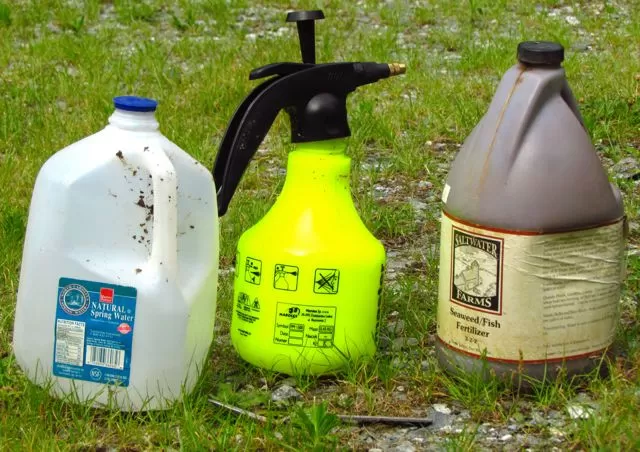
Foliar feeding tools, including a jug of fertilizer, measuring spoon, and hand sprayer.
The garden is bursting with life, growing visibly day by day. But even with the vigorous growth, I recently performed a foliar feeding. Now, for those unfamiliar with the term, “foliar meaning” refers to the practice of feeding plants through their leaves. Essentially, it involves spraying a diluted fertilizer solution directly onto the foliage, allowing for rapid nutrient absorption. This offers a much quicker boost compared to traditional soil fertilization. It’s a powerful tool in any gardener’s arsenal and a fascinating aspect of plant biology.
Foliar feeding, at its core, means providing nutrients directly to the plant’s vascular system through its leaves. As an organic gardener, I typically use a diluted mixture of fish emulsion and seaweed. My trusty gallon jug of this mixture has served me well for several seasons now. The mixing process is simple: a few tablespoons of the concentrate into a gallon of water, a good shake, and it’s ready to go. Precise measurements aren’t critical; a rough estimate works perfectly. One important note: fish emulsion can be quite pungent, so gloves are highly recommended.
I use a small hand sprayer for application, finding it far more manageable than the larger backpack sprayers I used in the past. While those larger sprayers are suitable for extensive gardens, this smaller one is ideal for my current, more compact space.
The key to successful foliar feeding lies in the timing. Never spray when the sun is directly on the plants, as the water droplets can magnify the sunlight and scorch the leaves. Aim for a fully shaded garden or a cloudy day. My garden usually doesn’t get full shade until later in the day, which presents a challenge. Spraying too close to nightfall risks mildew due to lingering moisture on the leaves. And let’s not forget the evening mosquito onslaught! Fortunately, a cloudy morning recently provided the perfect opportunity.
Beyond the immediate nutrient boost, foliar feeding has other significant benefits. I noticed a need for foliar feeding due to recent pest activity. After removing several tomato hornworms and discovering squash bug eggs, I knew the plants needed a boost in their defense mechanisms. Foliar feeding makes leaves less palatable to chewing insects and more resistant to diseases. The seaweed extract in my mix is rich in trace elements that fortify the leaves against these invaders.
I’ve even observed that deer seem to avoid daylily buds after I’ve sprayed them with the leftover solution. Perhaps seafood isn’t their cup of tea! The entire garden takes on a subtle oceanic scent after application, but it dissipates quickly as the leaves dry. On a typical humid summer day, drying can take an hour or so. No matter how careful I am, I always end up smelling of the solution myself, so a post-spraying shower is definitely on the schedule.
My vegetable garden is flourishing, with the first cherry tomatoes of the season already harvested. Squash plants are producing regularly, and the Y-Star Patty Pans, in particular, have been exceptionally flavorful.
My Fortex pole beans are also thriving, creating a verdant wall on their trellis.
Tiny bean pods are emerging among the blooms. Even the Jade bush beans, initially slow to start, are now catching up and producing abundantly.
The new Jade beans are significantly larger than the Fortex beans at this stage.
More cherry tomatoes are ripening quickly, and even the paste tomatoes are showing signs of turning red.
There’s always something exciting happening in the garden, and I’ve captured many of these moments in photos. I’ll be sharing more of the garden’s progress soon.
Foliar feeding, understanding its “foliar meaning,” is a valuable technique for any gardener. It provides an efficient way to deliver nutrients, boost plant health, and enhance resistance to pests and diseases. While timing and application are key, the rewards of a vibrant and productive garden are well worth the effort. We encourage you to share your own experiences with foliar feeding in the comments below! We’d love to hear your thoughts and tips. Also, feel free to share this article with fellow gardening enthusiasts.
Here's how implementing no-dig techniques can transform your container gardening: Build Richer Soil: Layers of…
Healthy soil is teeming with beneficial microbes that act as a natural defense system for…
Transform your patio into a vibrant, wildlife-friendly oasis. Discover how to create beautiful, low-maintenance container…
Unlock the secret to a beautiful, resilient garden with Sedum & Yarrow blends. Discover why…
Beat the Heat: Discover resilient perennials that thrive in containers during the hottest summer months,…
Variegated Pothos, like the Golden Pothos and Marble Queen, are stunning, easy-care houseplants perfect for…